

Long lead times, supply chain disruption and reduced visibility across global manufacturing networks have prompted many electronics businesses to reassess where products are made. For years, offshore production offered attractive unit costs and access to large-scale manufacturing capacity. Today, businesses are taking a broader view of manufacturing performance.
Reshoring electronics manufacturing is no longer driven solely by labour cost comparisons. Businesses are increasingly weighing responsiveness, production visibility, engineering collaboration and supply chain resilience alongside price. Delays, communication challenges and logistics complexity can directly affect product launches, customer commitments and operational efficiency.
For OEMs, procurement teams and operations leaders, the conversation is less about geography and more about control. Manufacturing strategy now plays a major role in business continuity, product quality and how quickly a business can respond when requirements change.
As a result, more organisations are exploring whether UK-based manufacturing partnerships can offer greater operational flexibility while reducing exposure to supply chain uncertainty.
Supply Chain Disruption and Manufacturing Delays
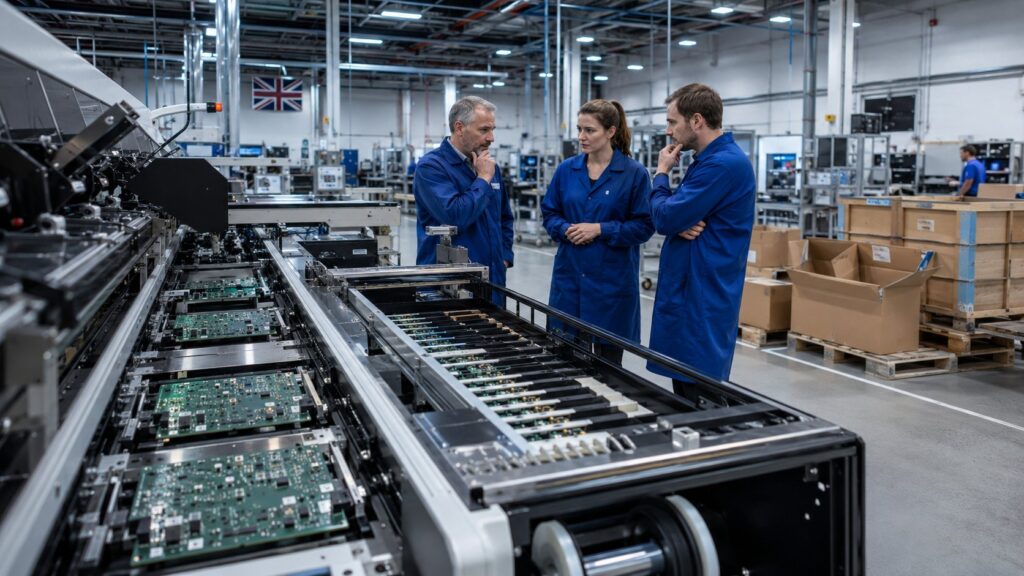
Many businesses are reconsidering overseas manufacturing because supply chain disruptions have increased delays, uncertainty and operational risk.
Electronics manufacturing depends on a complex network of component suppliers, distributors, logistics providers and production facilities. Disruption at any stage can quickly affect delivery schedules and customer commitments.
In recent years, businesses have faced component shortages, shipping bottlenecks, freight volatility and rapidly changing lead times. While global supply chains remain essential for many operations, these challenges have exposed the risks of long and fragmented sourcing routes. Component availability is one reason to assess the biggest PCB assembly supply chain risks before choosing a manufacturing model.
The impact goes beyond delayed deliveries. Product launches may slip, inventory requirements often increase and production schedules become harder to manage. Forecasting also becomes more difficult when manufacturing timelines are unpredictable.
Consider a product launch dependent on a single microcontroller. Even if 95% of the bill of materials is available, one delayed shipment can halt final assembly. The disruption may last only weeks, but the commercial consequences often last much longer.
These pressures are pushing businesses to evaluate manufacturing models that offer better responsiveness and shorter supply chains.
Scale Your Production
From prototype to full-scale electronic assembly, our UK facility is equipped to handle your requirements.
Get a QuoteFaster Lead Times Through UK Manufacturing
UK-based electronics manufacturing can reduce lead times by shortening logistics chains and improving production responsiveness.
Lead time is influenced by far more than factory capacity. Shipping schedules, customs processes, transport delays and communication cycles all contribute to the time required to move from design to delivery.
When manufacturing happens closer to the end customer, logistics complexity falls. Products spend less time in transit, revisions can be implemented faster and businesses gain more flexibility when demand changes unexpectedly.
This matters especially during product development. Engineering teams often need to adjust designs, validate prototypes or introduce specification changes. Long international supply chains can slow those workflows significantly.
A design change during production may require multiple approvals, revised documentation and updated shipping schedules. A UK manufacturing partner can usually review and implement changes more efficiently because the supply chain is shorter and collaboration is more direct.
Inventory planning also benefits, as more predictable lead times can reduce the need for excessive safety stock, improving agility without tying up working capital.
For many businesses, reshoring is not about achieving the lowest possible lead time, it is about creating a manufacturing setup that responds better when circumstances change.
Communication Between Businesses and Manufacturers
Closer communication between businesses and manufacturers can improve project visibility, problem-solving and production efficiency.
Manufacturing projects rarely proceed without design clarifications, engineering questions or specification changes. How quickly those issues are resolved often determines whether production stays on schedule.
When manufacturing takes place across multiple time zones, delays can accumulate quickly. A technical query raised during production may not receive a response until the next working day. If clarification is incomplete, delays continue.
This becomes particularly important during PCB assembly.
Small specification issues can create expensive downstream delays. A missing component lifecycle update, an unclear BOM entry or a Design For Manufacture (DFM) issue in a PCB layout can pause production while clarification is requested.
Working with a UK manufacturing partner often makes these conversations easier since engineering queries can be resolved faster, manufacturability feedback can be shared earlier and production teams can flag potential issues before they affect delivery schedules.
Businesses seeking closer engineering collaboration often benefit from working with a dedicated partner for PCB assembly, especially during prototype and early production phases.
The value of communication rarely appears in a unit-price comparison. Its importance becomes obvious when businesses need fast technical answers or immediate corrective action.
Engineering-Led Solutions
Work with a team that understands modern electronics and end-to-end manufacturing.
Our ExpertiseQuality Control in UK Electronics Manufacturing
Businesses reshoring electronics manufacturing often want greater visibility into quality assurance and production standards.
Quality management is not just about identifying defects. Effective quality systems provide traceability, consistency and confidence throughout production.
In electronics manufacturing, quality issues are not always immediately visible. Problems such as solder defects, component placement tolerances or thermal stress may only emerge during testing or, worse, after field deployment.
That makes process control especially important for OEMs producing high-reliability or safety-critical products.
When production takes place remotely, resolving quality issues becomes more difficult. Investigations often require additional reporting, longer communication cycles and limited access to production data.
Businesses may struggle to determine whether a problem originated from component sourcing, assembly processes or handling during transit.
Closer manufacturing relationships improve oversight. Inspection procedures, process controls and corrective actions become easier to review when communication channels are more direct.
Quality traceability is particularly valuable in electronics manufacturing. Businesses increasingly require detailed records covering component batches, production runs and testing procedures. This supports compliance and helps future product development.
This does not mean UK manufacturing automatically delivers better quality. Quality depends on process discipline, standards and execution regardless of location.
However, greater visibility often allows businesses to manage quality more proactively and resolve issues before they escalate.
Rising Overseas Manufacturing Costs

For some businesses, rising logistics, labour and supply-chain costs are reducing the financial advantages of overseas manufacturing.
Historically, labour costs drove many offshore manufacturing decisions, which remains true in many cases.
However, total manufacturing cost is now more complex than simple unit pricing.
Freight charges, customs administration, stockholding, currency volatility and rework can all materially affect cost. These factors are not always visible in supplier quotations.
A lower unit cost may appear attractive at first. Longer lead times and larger inventory requirements can significantly alter the financial picture.
A business may secure cheaper production overseas but absorb those savings through higher shipping costs, increased stockholding and operational delays.
This does not mean reshoring automatically lowers costs. Offshore manufacturing remains commercially advantageous for many products.
The key is understanding total operational cost rather than focusing only on unit price. For PCB projects, it helps to compare offshore and onshore assembly using the full cost of delivery.
Ready to start your project?
Contact our technical team today to see how Altimex can streamline your electronics supply chain.
Contact UsProtection of Intellectual Property
Some businesses are reshoring manufacturing to improve oversight and protection of sensitive product designs and intellectual property.
For organisations developing proprietary electronics, product designs are often a critical business asset.
Manufacturing relationships require sharing technical drawings, specifications, firmware information and production documentation. Businesses often want greater visibility into how that information is managed.
A closer manufacturing relationship can provide additional confidence through stronger oversight, clearer communication and tighter contractual controls.
This is particularly relevant for businesses developing specialised electronics, proprietary technologies or commercially sensitive innovations.
Reshoring does not guarantee intellectual property protection. Legal agreements, supplier governance and information security remain essential.
The advantage lies in greater operational visibility and control.
Shipping Costs and Logistics Challenges
International shipping volatility has made logistics planning more difficult for electronics manufacturers and OEMs.
Electronics products often rely on tightly coordinated supply chains. Delays affecting one shipment can disrupt production schedules, customer deliveries and inventory planning.
Global logistics networks provide access to manufacturing capacity, but they also introduce more variables.
Freight availability, customs delays, transport disruption and changing shipping costs all influence manufacturing timelines.
When products move across multiple regions before reaching their destination, forecasting becomes harder. Businesses often need larger inventory buffers, increasing storage costs and tying up working capital.
A delayed shipment of key components can trigger a chain reaction across production.
Local manufacturing does not remove logistics challenges entirely, particularly when components still come from overseas.
However, reducing the distance between manufacturing and customers can simplify large parts of the supply chain and improve responsiveness when disruption occurs.
Supply Chain Visibility and Transparency
Businesses increasingly value supply-chain transparency because it improves planning, communication and operational control.
Visibility is central to modern manufacturing management. Decision-makers need accurate information to forecast demand, manage inventory and respond to changing market conditions.
Limited visibility creates uncertainty. Production delays may remain hidden until delivery dates start slipping. Component shortages may emerge too late for alternative planning.
Greater transparency helps businesses identify risks earlier and respond faster.
A collaborative manufacturing relationship supports clearer production tracking, faster escalation and improved forecasting. Teams gain better insight into production status, material availability and potential constraints.
If a bottleneck develops during production, early visibility allows businesses to make informed decisions around scheduling, procurement or resource allocation.
For organisations seeking tighter operational control, transparency has become a major factor in manufacturing strategy.
Product Development and Manufacturing Speed
Closer manufacturing relationships can help businesses move from design to production more efficiently.
Product development rarely follows a straight path. Prototypes evolve, specifications change and engineering teams refine designs throughout development.
The speed at which manufacturing supports these changes affects time-to-market and project efficiency.
Long communication chains and extended logistics routes slow iteration cycles. Design changes can become stuck in approval processes before production updates happen.
A local manufacturing partner creates a more collaborative workflow. Engineering teams gain faster access to manufacturing expertise and technical feedback can be incorporated earlier.
This becomes especially valuable during prototyping and pilot production.
For example, an engineering team may identify a PCB layout issue during testing. Rapid communication with manufacturing can shorten revision cycles and reduce delays before full production begins.
Manufacturing speed is not simply about producing units faster. It is about reducing friction between design, engineering and production.
Businesses focused on innovation increasingly value manufacturing relationships that support rapid iteration and informed decision-making.
Sustainability Within Electronics Manufacturing
Some businesses are reviewing manufacturing location choices as part of broader sustainability and supply chain reporting goals.
Environmental considerations increasingly influence procurement and supplier evaluation.
Manufacturing location can affect transport requirements, logistics efficiency and supply chain reporting complexity.
Shorter transport routes may reduce logistics-related emissions. Better production planning may also reduce waste from excess inventory or emergency shipments.
These benefits should be assessed carefully. Sustainability outcomes depend on manufacturing processes, transportation methods and sourcing decisions.
Reshoring should not be treated as an automatic sustainability solution.
Instead, it may form part of a broader strategy centred on responsible sourcing, operational efficiency and improved supply chain visibility.
As reporting requirements evolve, businesses increasingly value reliable information from manufacturing partners.
Reshoring electronics manufacturing is rarely about simply bringing production closer to home. More often, it is about improving control, reducing operational friction and building a supply chain that can respond when conditions change.
For many organisations, the conversation extends far beyond manufacturing costs. Lead times, communication, quality oversight, supply chain visibility and engineering collaboration all influence long-term performance.
UK manufacturing will not be the right solution for every business. Offshore production remains commercially valuable across many sectors. The key is understanding which operational factors matter most to your organisation.
If you are reviewing manufacturing options and want practical advice on UK-based PCB assembly or electronics production, contact us at Altimex to discuss the most suitable approach for your product, volumes and supply chain requirements.