

There is no universal board quantity at which PCB assembly changes from low volume to high volume. Manufacturers use these terms differently because production scale depends on more than the number of boards in one order.
For engineers, product managers and procurement teams, the useful question is not only whether a requirement is “low volume” or “high volume”. It is whether the design, bill of materials (BOM), testing needs, delivery schedule and expected repeat demand support the proposed manufacturing approach.
This guide explains how the terms are used, why published thresholds vary and what information to give a manufacturer when discussing PCB production quantities.
What Is Low Volume PCB Assembly
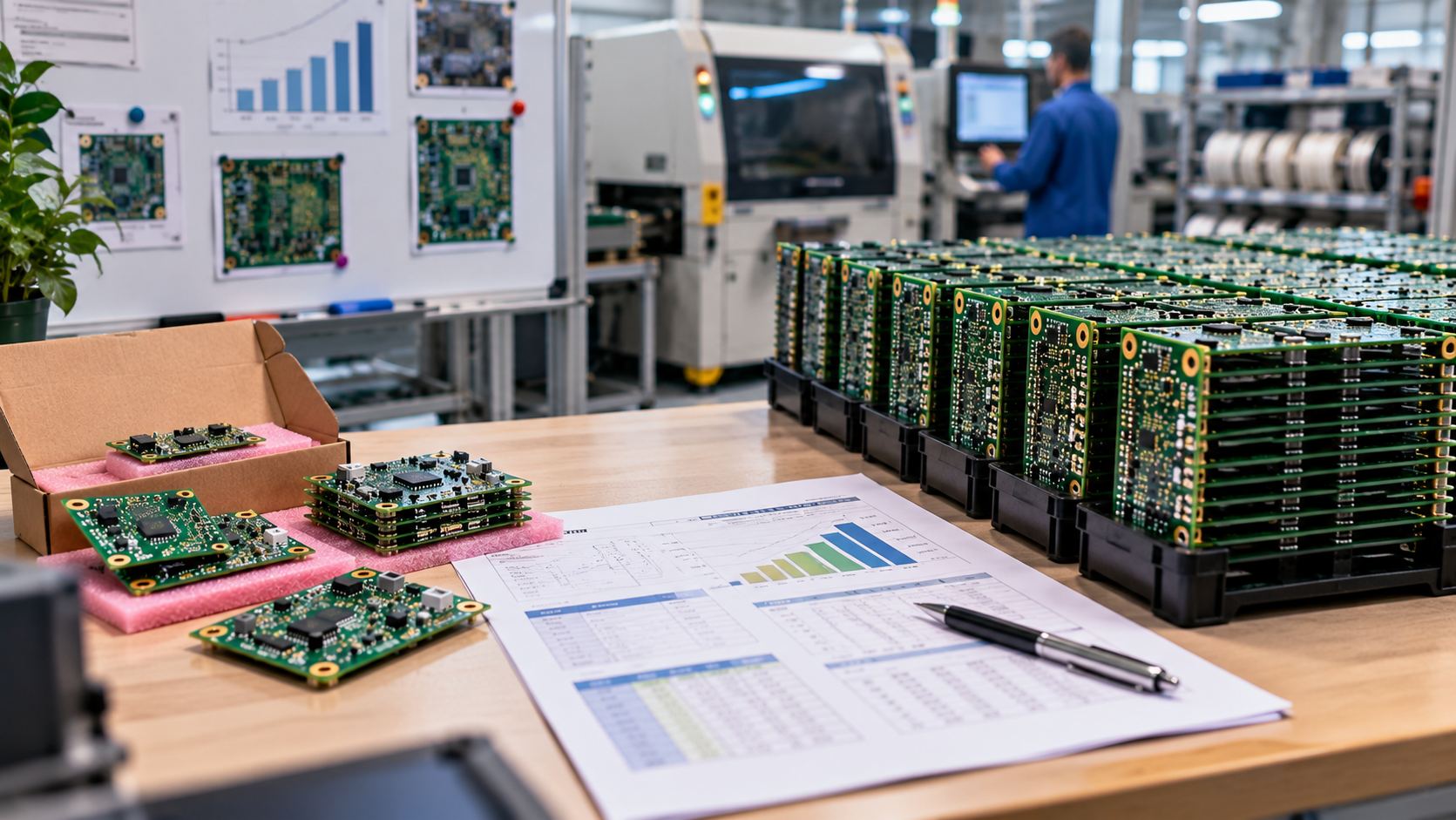
Low volume PCB assembly generally describes smaller production quantities where flexibility, design maturity and changing demand may matter more than maximising production scale.
The term can cover several commercial situations. A product may still be moving through validation, demand may be uncertain, or the market itself may only require modest quantities. Some specialist products also remain low volume throughout their lifecycle because annual demand never justifies larger production runs.
Low volume should not be treated as another word for prototype. A prototype run is primarily used to prove a design, test functionality or support development. Commercial low volume production can involve stable, saleable products manufactured repeatedly in smaller batches.
For example, a specialist equipment manufacturer may order a relatively small number of populated boards every quarter for an established product. Another company may order a similar quantity while a new design is still being validated. The board count could look similar, yet the manufacturing considerations are different.
That distinction matters because the assembler needs to understand whether the requirement is stable and repeatable, or whether revisions remain likely.
Scale Your Production
From prototype to full-scale electronic assembly, our UK facility is equipped to handle your requirements.
Get a QuoteWhat Is High Volume PCB Assembly?
High volume PCB assembly refers to larger, repeatable production requirements where process stability, component supply and manufacturing efficiency become increasingly important.
Higher quantities usually place greater emphasis on consistent documentation, reliable component sourcing, repeatable testing and controlled manufacturing processes. The product design also needs to be sufficiently mature for repeated production.
An established electronic product with predictable recurring demand is a typical high volume scenario. The manufacturer can plan around known specifications, expected quantities and a more consistent production pattern.
A large board order is not automatically a good candidate for higher-volume production. If the design is still changing, key parts are difficult to source or testing requirements remain unresolved, ordering more units does not remove those risks. It can increase their commercial impact.
The useful distinction is therefore not just “small order” versus “large order”. High volume production works best when the wider project is ready for repeatability.
Is There a Standard Number That Defines PCB Production Volume?
No single quantity universally defines low or high volume PCB assembly. Manufacturers may use different thresholds according to their equipment, processes, customer base and typical production requirements.
This is why online definitions can appear contradictory. One electronics manufacturing services provider, for example, describes quantities below 1,000 boards as low volume and 1,000–100,000 boards as high volume. This is a manufacturer specific classification, not an industry standard.
Another assembler may use different bands because its business model, production setup or usual project size differs. Even the same quantity may be assessed differently depending on board complexity, sourcing requirements or repeat order expectations.
For buyers, rigid labels can therefore create more confusion than clarity. Asking whether a supplier provides “high volume PCB assembly” gives less useful information than explaining the expected run size, annual forecast, delivery schedule and production frequency.
The same applies when reviewing Altimex’s PCB assembly service. The starting point should be the actual manufacturing requirement rather than an assumed industry threshold.
Engineering-Led Solutions
Work with a team that understands modern electronics and end-to-end manufacturing.
Our ExpertiseTypical PCB Assembly Volume Ranges
Published PCB volume ranges should be treated as indicative examples rather than fixed industry categories because manufacturers define production scales differently.
| Classification | Indicative meaning | Important caveat |
| Prototype | Small quantity primarily used for design validation or testing | Prototype work is not the same as commercial low volume production |
| Low volume | Smaller or more flexible production requirement | Exact quantities vary by manufacturer and project |
| High volume | Larger, stable and repeatable production requirement | Thresholds differ, and quantity alone does not determine suitability |
This approach is more useful than assigning a universal numerical band. It keeps the focus on what the manufacturer needs to plan, source, assemble and test the boards effectively.
If a supplier publishes its own volume categories, treat them as a guide to that supplier’s operation. They can help frame an enquiry, though they should not be assumed to apply across the PCB assembly industry.
What Factors Determine Whether a PCB Order Is Low or High Volume?
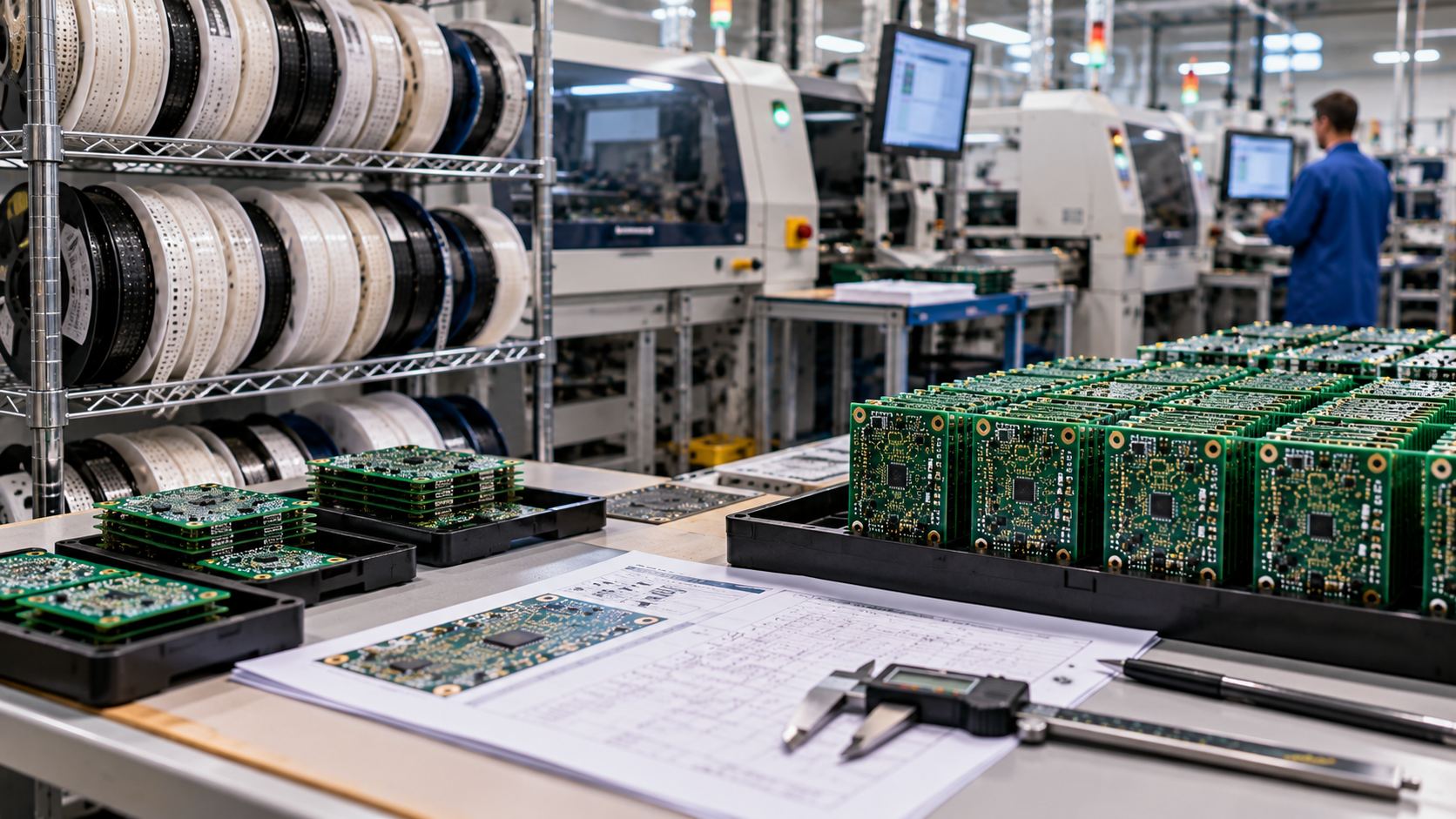
Board quantity is important. Manufacturers also need to consider complexity, design maturity, components, testing and how frequently production will repeat.
These factors affect how the job should be planned and whether a stated quantity gives an accurate picture of the manufacturing requirement.
| Factor | Why it matters |
| Quantity per run | A one-off order of 1,000 boards presents a different planning requirement from ten repeat orders of 100 boards |
| Annual demand | Forecast quantity helps the manufacturer understand the likely longer-term production pattern |
| Order frequency | Regular repeat orders can influence component planning, scheduling and manufacturing continuity |
| PCB complexity | Dense layouts, mixed technologies or unusual assembly requirements can change the work involved at the same board quantity |
| Design maturity | A released, stable design is different from an assembly that may still require revision |
| Bill of materials | Component availability, approved alternatives and sourcing constraints can affect production planning |
| Testing requirements | Functional testing, inspection and other quality checks can add time and process requirements |
| Delivery schedule | One delivery date creates a different production problem from phased releases across several months |
Consider two projects requiring 1,000 boards. The first uses a mature design with approved components and established test requirements. The second is a complex assembly undergoing revision, with several components still being evaluated.
The headline quantity is identical. The manufacturing proposition is not.
Understanding everything to know about the PCB assembly process helps explain why these details matter. Assembly involves more than placing components onto a board. Documentation, sourcing, preparation, inspection and testing all influence how production should be approached.
Ready to start your project?
Contact our technical team today to see how Altimex can streamline your electronics supply chain.
Contact UsHow Does the Assembly Process Change at Higher Volumes?
As PCB quantities increase, manufacturers can place greater emphasis on repeatability, production efficiency, component purchasing and stable manufacturing processes.
At lower quantities, flexibility may carry more value because demand, schedules or designs can still change. At higher quantities, inconsistencies become more significant because any issue can affect a larger number of assemblies.
| Lower volume considerations | Higher volume considerations |
| Greater scope for smaller batches | Greater need for repeatable production conditions |
| Demand may be less predictable | Forecasts may support more structured planning |
| Design changes may remain possible | Stable documentation becomes increasingly important |
| Component requirements may be bought around individual runs | Procurement needs may be planned across repeat demand |
| Testing may evolve with the product | Test methods need to remain consistent across production |
Automation can form part of higher volume manufacturing, depending on the assembler and the board itself. It should not be assumed that every higher volume project uses the same production route, or which automation alone defines high volume.
The important change is the growing value of consistency. As more boards are produced, stable inputs and controlled processes reduce the risk of carrying the same problem through repeated batches.
How Do Production Volumes Affect PCB Assembly Costs?
Production quantity can affect PCB assembly cost. The relationship is not simply “more boards equals cheaper boards” because components, setup, testing, complexity and logistics all contribute.
Some activities are required before production starts regardless of the number of finished assemblies. Depending on the project, these may include production preparation, programming, documentation checks or test setup. Spreading such work across more units can change the cost profile.
Other costs rise directly with the requirement. Components must still be sourced, boards assembled and relevant tests completed. Expensive or constrained parts can dominate the commercial picture even when the order quantity rises.
Key cost drivers include:
- PCB and component prices
- production preparation and setup
- assembly complexity
- component placement requirements
- inspection and testing
- manual operations
- packaging and logistics
- delivery timing
- sourcing constraints or approved alternatives
This is why unit price should not be assessed from volume alone. A larger quantity with complex testing and difficult components can present a very different cost structure from a stable assembly with fewer production demands.
A project specific quotation is more useful than assuming a particular volume category will produce a particular unit cost.
When Is Low Volume PCB Assembly the Right Choice?
Lower volume production can be appropriate when demand remains uncertain, the product is specialised, changes remain possible or large quantities are simply unnecessary.
It may suit:
- specialist industrial or scientific equipment with modest annual sales
- new products entering a controlled commercial launch
- designs where further revision is possible
- products with demand that is difficult to forecast
- projects where the buyer wants repeat deliveries in smaller batches
- established products serving narrow markets
A manufacturer of specialist industrial equipment, for example, may only need a few production batches each year. If the product is profitable and demand is stable at that level, moving to a much larger order may create stock without solving a manufacturing problem.
Low volume production is therefore not an inferior stage which every product must leave. For some products, it is the appropriate long-term model.
The key question is whether the batch size supports demand, stock requirements, design status and purchasing constraints.
When Should a Business Consider High Volume PCB Assembly?
Higher volume production becomes relevant when demand justifies it and the design, component strategy and manufacturing process are sufficiently stable to support repeatable output.
Before increasing production quantities, check whether:
- demand is supported by credible orders or forecasts
- the PCB design is stable
- manufacturing documentation is current
- the bill of materials is controlled
- critical components can be sourced reliably
- approved substitutions are understood where relevant
- testing requirements are defined
- delivery expectations are clear
- future repeat demand is reasonably visible
“We need more boards” is not enough on its own. A higher production quantity increases the importance of every unresolved issue because the impact can extend across more assemblies and more purchased material.
The decision should therefore reflect readiness as well as demand.
How Can a Business Move from Low to High Volume Production?
Moving to higher production volumes requires more than increasing the order quantity. The design, documentation, components, testing requirements and forecast should all be ready for more repeatable manufacturing.
A concise transition check is to:
- confirm the design and revision status
- review the bill of materials and component availability
- define inspection and testing requirements
- check manufacturing documentation for consistency
- provide realistic demand forecasts
- agree expected batch sizes and delivery schedules
This article intentionally stops short of a full production planning process. Moving from smaller runs into sustained repeat production involves broader forecasting, procurement and manufacturing readiness decisions which should be considered as a separate planning exercise.
How to Discuss Production Volumes With a PCB Assembly Manufacturer
Give the manufacturer both your immediate requirement and the wider production picture so they can assess the project rather than relying on a “low volume” or “high volume” label.
A useful enquiry should include:
- quantity required for the next production run
- expected annual quantity
- likely repeat order frequency
- target delivery dates
- PCB design and revision status
- bill of materials status
- known component constraints
- testing and inspection requirements
- expected changes in future demand
Compare “I need low volume PCB assembly” with a more useful description such as: “We need an initial batch of 200 assemblies, expect repeat orders every two months and currently forecast around 1,200 units across the year. The design is released, although two components are under sourcing review.”
Those figures are illustrative, yet the example shows why context matters. The manufacturer can see the immediate batch size, likely repeat pattern, annual demand and current project risk.
You do not need to decide whether your requirement technically counts as low or high volume before approaching a supplier. Accurate project information gives the manufacturer a better basis for discussing production options, sourcing and scheduling.
If you have a defined requirement or are still working through likely production quantities, contact us with your expected volumes, schedule and project requirements to discuss your PCB assembly needs.